Programme
- Giacomo PucciniMadama Butterfly
About
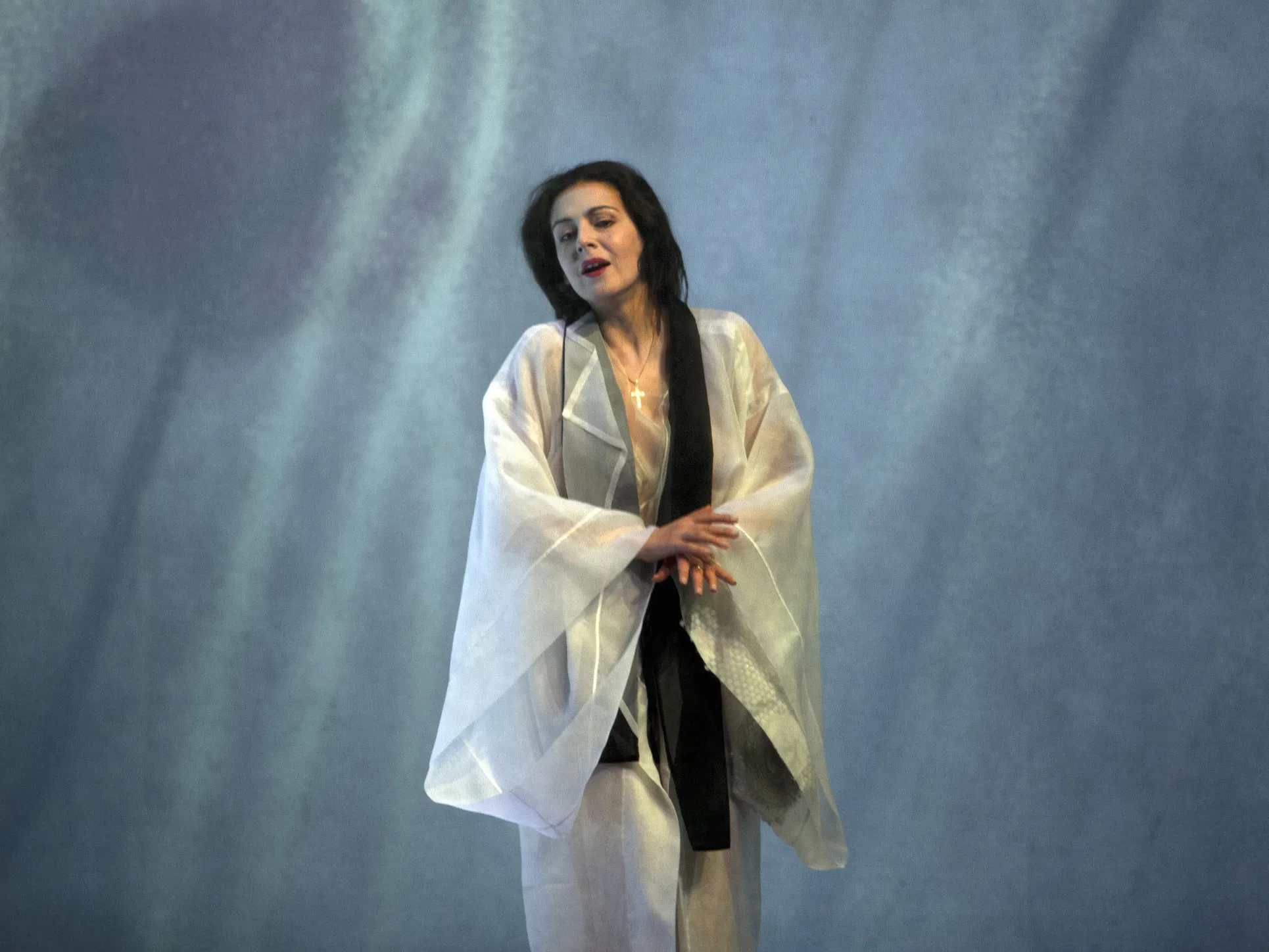
Here two worlds meet: A man uses a system that grants him power; a girl pays the price for believing in security. The American naval officer Pinkerton marries in Japan the 15-year-old geisha Cio-Cio San – fully aware that this marriage can just as easily be dissolved as it was formed. For Cio-Cio San, this connection represents the hope for a new life. In Vincent Boussard's staging from 2012, we follow a young woman who gradually distances herself from reality. Everything begins to be saturated with cherry blossom petals, intricately draped kimonos define the costume design of the first act, and faces are smudged with stylized geisha makeup. The opulent costumes by fashion designer Christian Lacroix and the concept of the staging draw upon an aesthetic that has shaped the reception of Madama Butterfly for more than a century. It is a visual world that does not depict Japan as a concrete societal reality in a specific time, but rather above all as a projection of Western fantasies: beautiful, seductive, and 'foreign'. The story of this opera does not only tell the story of an unequal relationship with a considerable power imbalance between two people. It also tells the story of perceptions and power relations of a Western gaze. It shows how images of other cultures are constructed as constructs and what consequences this can have up to today. The term 'exotism' describes exactly this mechanism. It refers to the tendency to perceive non-European cultures as particularly 'foreign', fascinating, or seemingly original. What is lost in this process is the complexity of real life worlds. Instead, images are created that reveal a great deal about the wishes, longings, and fears of those who create and look at them. Such images are not coincidentally created. They are connected to the political and economic power relations of the 19th and early 20th centuries. While European states and the USA expanded their influence worldwide, a cultural fascination for the regions of the world perceived as 'foreign' also developed. Art, literature, music, and theater became places where these perceptions were produced and spread. Puccini's opera is also firmly rooted in this tradition. Pinkerton moves from the beginning from a position of security and superiority. For him, Japan is a place of experience, consumption, and adventure. The encounter with Cio-Cio San is always reversible. For her, the same relationship is a utopia; it is existential. In this context, the question of cultural appropriation also gains significance. This does not refer to every form of cultural exchange. Cultures have always been in relation with each other. Appropriation becomes problematic where elements of a suppressed culture are adopted, aestheticized, or consumed, while the historical, social, or political contexts are left out. Boussard's staging makes these mechanisms visible by not simply confirming its own aesthetics, but reflecting them, by placing two aesthetics against each other. The first act deliberately moves within those romanticized Japanese images that have accompanied the work since its creation. However, after the interval, the perspective shifts. While only a few minutes have passed for the audience, three years of waiting lie behind Cio-Cio San. The stage space has changed. The coded Japanese world has disappeared. In its place appears an American-influenced everyday life with Chesterfield sofas, jeans, and the atmosphere of an urban loft. This contrast is more than a scenic effect. It makes visible that both main characters move within the perceptions of each other's cultures – albeit under completely different circumstances
Tickets & info ↗