Programme
- Richard StraussAriadna na Naxos
About
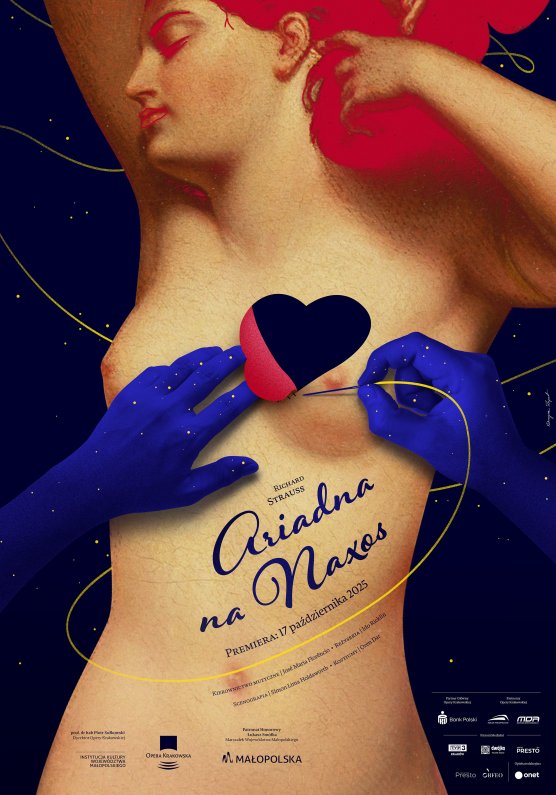
For over a century, the creators of "Ariadne on Naxos" have been playing with their audience. Richard Strauss's opera is a story about us – about how we try to reconcile reason with emotion, and art with everyday chaos. The collaboration between the composer and the acclaimed playwright and poet Hugo von Hofmannsthal resulted in a story about the intersection of different worlds: melancholy and laughter, despair and immortality, ideas and reality. It is also a colorful, artistic patchwork, whose neatly stitched-together parts form reflections on the value of different theatrical genres and the role of the artist in art. The plot of the spectacle, which masterfully combines elements of seriousness and comedy, consists of two parts: the Prologue and the main opera. The Prologue shows the preparations for an artistic evening in the residence of a wealthy patron of the arts, who had commissioned two performances for his guests: a serious opera about the mythological Ariadne and a comic opera featuring a troupe of traveling actors. Due to time constraints, the patron orders both works to be performed simultaneously. The artists, initially outraged, are forced to compromise and adapt to the new, absurd situation. The second part takes us to the mythical island of Naxos, where the titular Ariadne is distraught after her separation from Theseus. The grieving daughter of the King of Crete is comforted by a troupe of clowns and the god Bacchus himself. Will we finally get a happy ending in the old, good style?
"Ariadne on Naxos" is the third opera created by the Strauss-Hofmannsthal duo. It was originally conceived as part of the "The Bourgeois Gentleman" (premiere on October 25, 1912, at the Hoftheater in Stuttgart). When Strauss began working on his work, he saw it more as a trifle – unlike Hofmannsthal, who saw great potential in the composition from the outset. It was only through correspondence between the two that Strauss became more enthusiastic about his work. Despite its great success, the "Ariadne" portion of the spectacle quickly disappeared from the program. Hofmannsthal could not bear to see Strauss's work go unnoticed, and he eventually convinced Strauss to give his creation a second life and transform it into a standalone theatrical work. The premiere of "Ariadne" at the Vienna Hofoper (October 4, 1916) was a great success, and the composition quickly became part of the world's operatic repertoire. Is "Ariadne on Naxos," a co-production of the Krakow Opera, the Tel Aviv-Jaffa Opera, and the Dortmund Opera, another iteration of the age-old question: to have or to be? It is worth experiencing this for yourself.
Tickets & info ↗