About
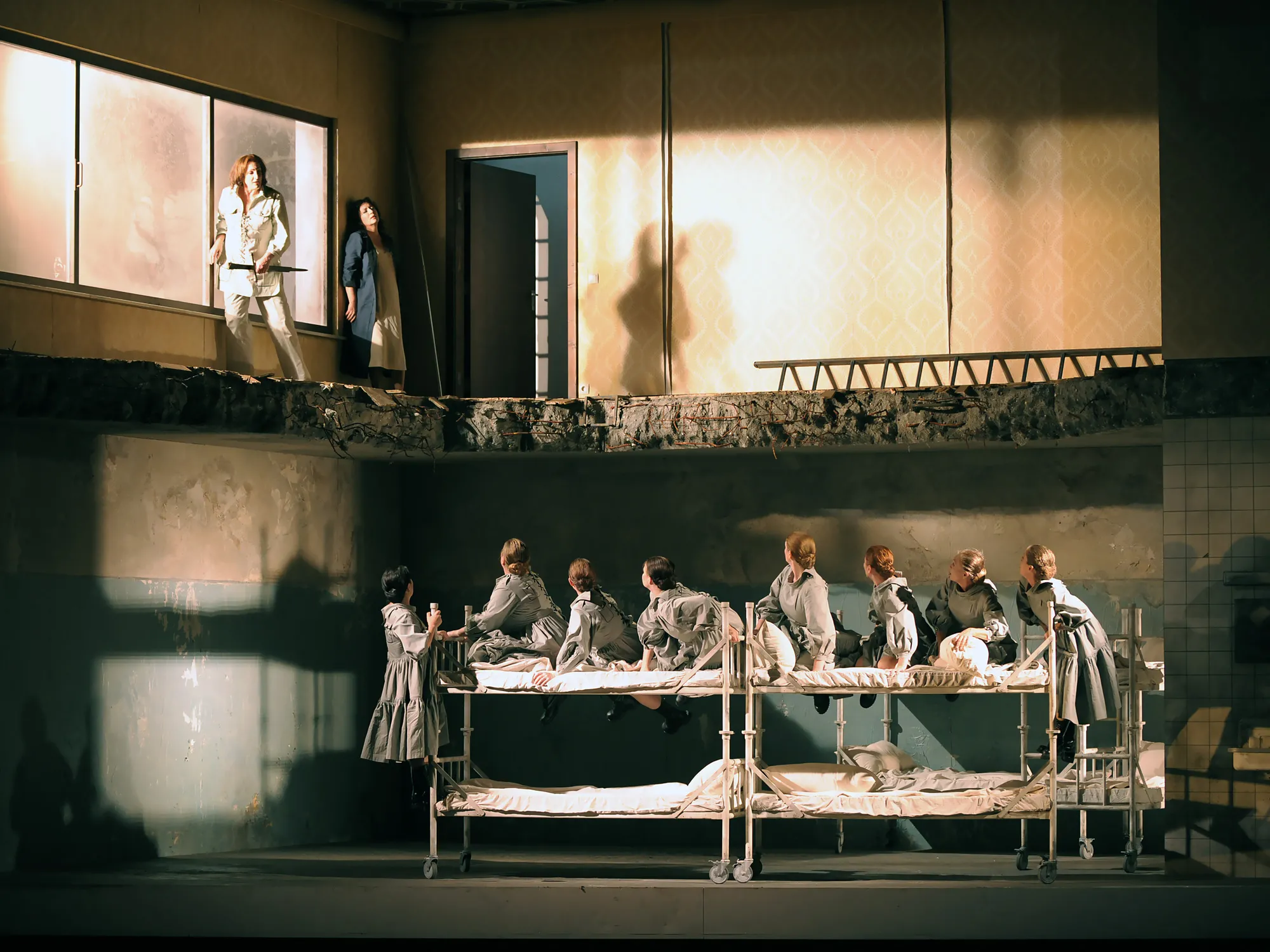
He thought big. Until today, Wagner's grandeur, partly also his megalomania, remains a culmination of the 19th century – with all its light and also much shadow. With Der Ring des Nibelungen, Richard Wagner certainly did not simply create an opera cycle, but the outline of his own mythology: nothing less than the origin and end of a whole world of gods, Nibelungen, giants, and humans. Das Rheingold, Die Walküre, Siegfried, and Götterdämmerung together form that monumental artwork, which he worked on over two decades. At the Hamburg State Opera, this entire Ring is not on stage this season, but rather the part that captures the human essence of the world narrative. While Das Rheingold takes place in an archaic world of gods, nixes, giants, and dwarves, Die Walküre brings humans to the center. The natural spaces of the 'Vorabend' give way to a hut in the forest – decisively private is the framework of this opera. Cosmic power shifts become here a family catastrophe, the world becomes a relationship story. After Das Rheingold, in which the Nibelung Alberich brings a curse upon the world through the theft of gold and godfather Wotan secures the foundations of his rule, begins with Die Walküre the actual Ring. At the center are Wotan's mortal children Siegmund and Sieglinde, both unaware that they are siblings. They will fall in love with each other and thus challenge the order. When Wotan tries to control the consequences of this love, he gets caught in a conflict between power and compassion, law and freedom. His favorite daughter Brünnhilde finally rebels against his will and is punished for it. With her disobedience, she sets in motion the development that is continued in Siegfried: The title hero, born from the union of Siegmund and Sieglinde, grows up and awakens Brünnhilde from her magical sleep. In Götterdämmerung, their shared fate ultimately leads to destruction. The Ring in short: world created, world destroyed. At the center of Die Walküre meet three people: Siegmund, Sieglinde, and her husband Hunding. Hardly has the fleeing stranger closed the door to Hundings house behind him, that one of the most intense love dramas in opera history begins. Wagner condenses here his central theme – the conflict between love and power – into a constellation that, despite all its mythological disguise, surprisingly modern. Marriage, desire, freedom, social order, and individual self-determination clash. Here are found all the decisive conflicts of the cycle: the contrast between law and compassion, the question of freedom and fate, the rebellion against existing orders, and the possibility of defying the expectations of one's own origin. The great ideas of the Ring appear in human form. That is why Die Walküre is suitable for a performance as an independent evening. Claus Guth's staging was created as part of his Hamburg Ring narrative from 2008 to 2010. Guth is among the most significant opera directors of today and has made a name for himself particularly through his Wagner productions. He directed, among others, Der fliegende Holländer in 2003 at the Bayreuth Festival, Tristan und Isolde in 2008 at the Zurich Opera House, Die Meistersinger von Nürnberg in 2010 at the Semperoper Dresden, Parsifal in 2012 at the Gran Teatre del Liceu in Barcelona, Lohengrin in 2012 at the opening of the Milan Scala under Daniel Barenboim, and Tannhäuser in 2021 at the Vienna State Opera. Together with his long-time stage and costume designer Christian Schmidt, Guth developed for his Hamburg Ring a visual and conceptual world that holds the entire cycle together. Their concept shows a Wotan who constantly refines his models for the domination of the world and plays them out in small and large table models